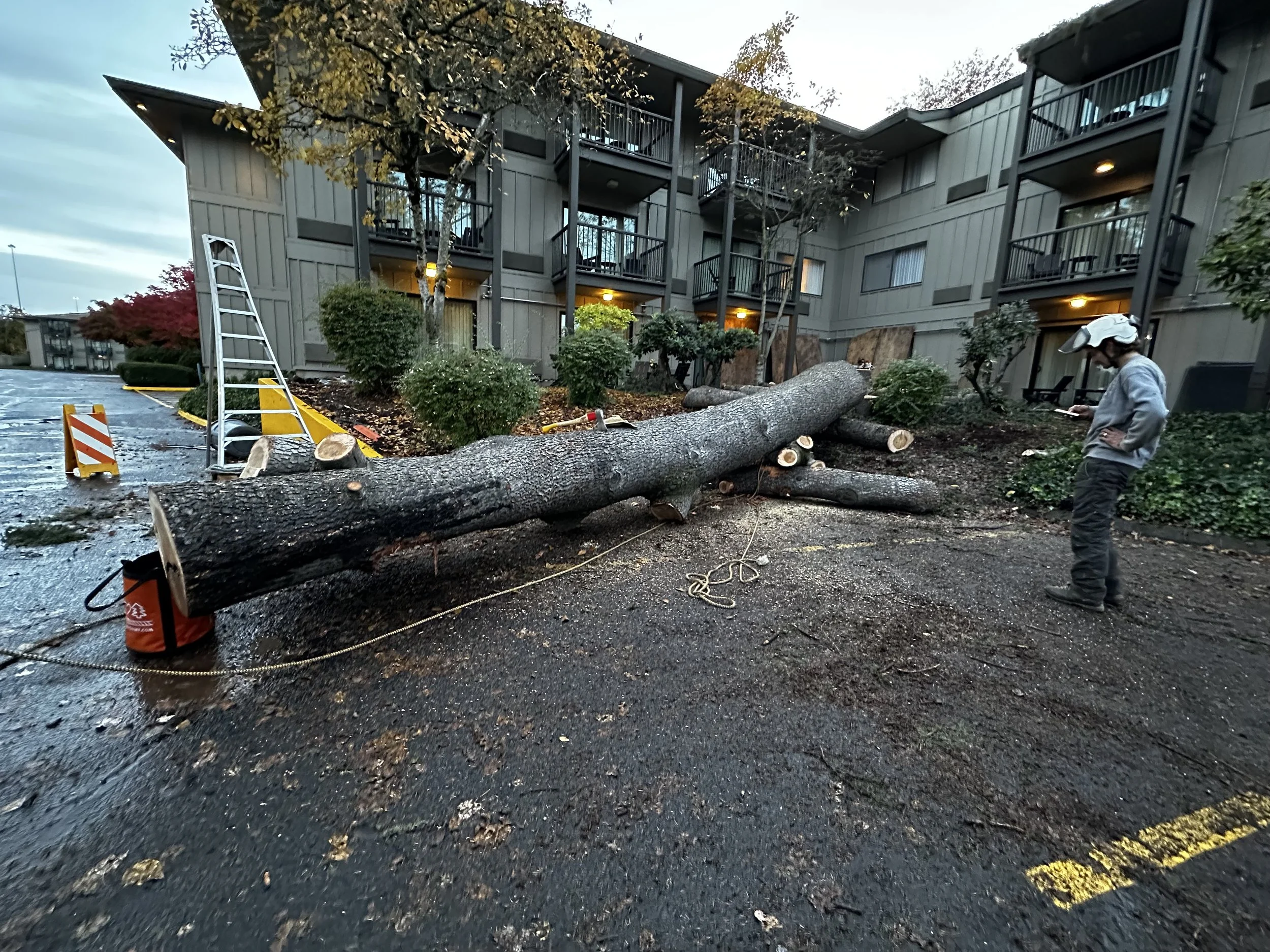
Winter Ice and Tree Failure: Why Trees Break When the Ice Comes
Winter ice storms are among the most destructive weather events for trees. Unlike snow—which is relatively light—ice adds enormous weight to branches, crowns, and entire tree structures. When that added load exceeds a tree’s mechanical limits, failure becomes likely. Understanding how and why ice causes trees to fail can help property owners recognize risk and take preventative action before damage occurs.
How Ice Loads Trees
Ice forms when freezing rain coats branches, twigs, and foliage. Just a quarter inch of ice can add hundreds of pounds of extra weight to a mature tree. That weight is distributed unevenly, often concentrating on outer branches where leverage forces are greatest. As branches bend under the load, internal wood fibers are stressed beyond their elastic limit, leading to cracking, splitting, or sudden breakage.
Evergreen trees are particularly vulnerable because their needles retain ice efficiently, increasing surface area and weight. Deciduous trees without leaves generally fare better—but defects such as weak branch attachments, decay, or poor structure can still lead to failure.
Common Types of Ice-Related Tree Failure
Ice storms tend to reveal pre-existing weaknesses rather than creating entirely new ones. The most common failure modes include:
Branch breakage: Long, horizontal limbs are especially prone to snapping under ice load.
Split unions: Codominant stems—two or more stems of similar size growing together—often split apart due to included bark and poor load distribution.
Top failure: Tall trees may lose their upper crowns as ice and wind combine to create extreme bending forces.
Whole-tree uprooting: When ice is paired with saturated winter soils, root systems may lose anchorage and tip over completely.
The Role of Wind and Soil
Ice alone is dangerous, but ice plus wind is far worse. Wind adds dynamic loading, causing iced branches to sway and oscillate, rapidly increasing stress. At the same time, winter soils are often waterlogged, reducing root grip. Trees that might otherwise hold can suddenly fail at the root plate.
Why Healthy Trees Still Fail
Even well-maintained trees can suffer damage in severe ice events. Wood has natural strength limits, and ice storms can exceed what any living structure can tolerate. However, trees with good structure, strong branch unions, and minimal decay consistently outperform neglected or poorly pruned trees.
Reducing Risk Before the Ice Hits
While no tree can be made ice-proof, risk can be significantly reduced through proactive care:
Structural pruning to shorten overextended limbs and reduce leverage
Early correction of codominant stems
Removal of dead, cracked, or decayed wood
Species selection favoring strong-wooded, storm-resilient trees
Importantly, trees should never be shaken or struck to remove ice—this often causes immediate breakage.
After the Storm
Post-storm inspections are critical. Cracks, hanging limbs, and partially failed branches may not fall immediately but can remain hazardous long after the ice melts. Prompt professional assessment helps prevent delayed failures that pose serious safety risks.
Final Thoughts
Winter ice doesn’t just test trees—it exposes their history. Good structure, proper pruning, and sound root systems dramatically improve survival. Ice storms are inevitable, but catastrophic tree failure doesn’t have to be. Investing in tree care before winter arrives is one of the most effective ways to protect homes, people, and the trees themselves.